Inside Mont Saint-Michel Abbey, Level by Level
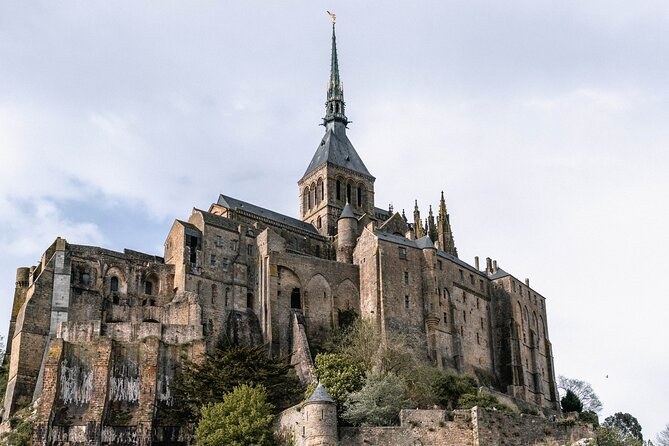
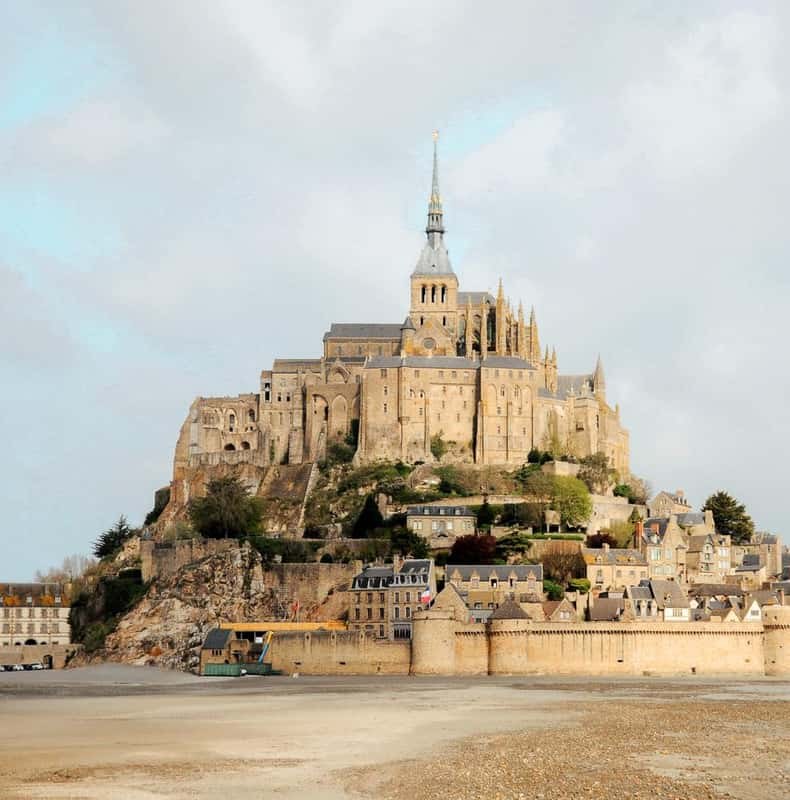
The short answer. The abbey is not laid out on a plan, it is stacked on a cone. You enter near the bottom, climb through crypts that exist to hold the church above them, reach the abbey church on the summit, cross into the cloister and refectory of La Merveille, and come out on the west terrace with the whole bay in front of you. Around 150 steps, and about an hour and a quarter if you take it steadily. Departures that include it are on Mont Saint-Michel Tours.
Why it is vertical
The summit of the rock is not big enough for a church. When work began around 1023 the builders solved that by constructing crypts out from the granite on three sides and resting the abbey church on top of them. Everything you walk through on the lower levels is doing structural work as well as being a room. That is the single idea that makes the building legible.
The levels, bottom to top
| Level | What is there | Roughly |
|---|---|---|
| Entrance and almonry | The lowest halls, where the poor were received | 10 minutes |
| The crypts | Massive piers built to carry the church above | 10 minutes |
| The abbey church | Romanesque nave, flamboyant Gothic choir | 20 minutes |
| The cloister | Top floor of La Merveille, open to the sky | 15 minutes |
| The refectory | The monks’ dining hall, lit from hidden windows | 10 minutes |
| The west terrace | The open platform in front of the church | As long as you like |
The order of the visit. Times are what most visitors take rather than a published schedule.
The abbey church
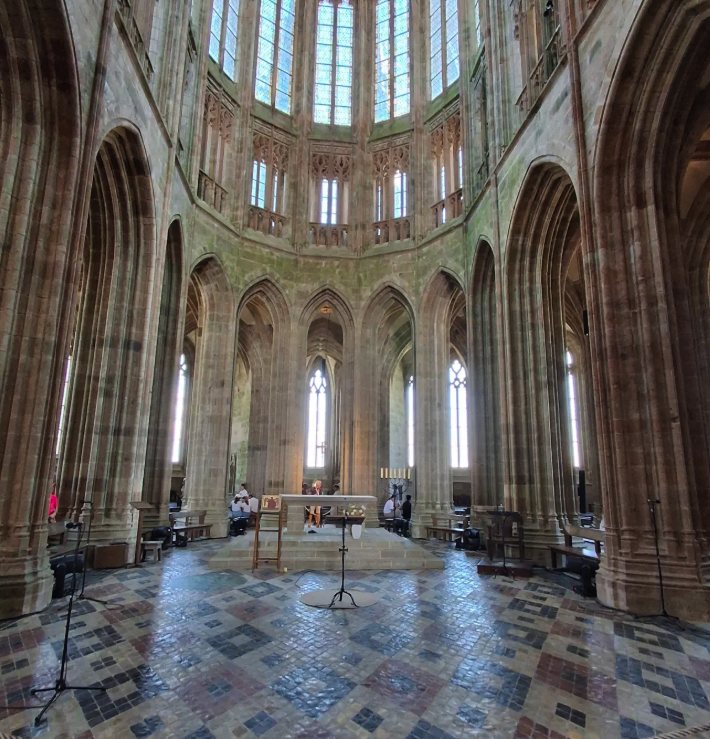
Begun around 1023 and finished over generations. The nave is Romanesque: round arches, heavy walls, the architecture of the eleventh century. The choir at the east end is not. In 1421, during the Hundred Years War, the Romanesque choir collapsed, and it was not rebuilt until a century later in flamboyant Gothic. Standing in the crossing you can see both centuries at once, which is the clearest lesson in medieval building anywhere on the island.
La Merveille
Two three-storey buildings raised against the north face in the thirteenth century, stacked rather than spread because there was no ground to spread onto. The name means “the Marvel”. The top floor carries the cloister and the monks’ refectory, and it is the part of the abbey most people remember afterwards.
The cloister is a garden in the air with a double row of slender columns, ninety metres above the sea. The refectory next to it is a long hall whose windows are hidden in the thickness of the walls, so the light arrives without you being able to see where from.
Stand still in the refectory for a minute. The acoustics and the concealed lighting were designed for silent meals read aloud to, and both still work.
The west terrace
The open platform in front of the church, and the best free view in the bay. From here you can read the tide across the whole property, see Tombelaine three kilometres north, and on a clear day pick out the Breton coast to the west. It is also where the scale of the building finally makes sense.
The prison years
From the seventeenth century the abbey was progressively converted into a state prison, and after the Revolution the monks left altogether. Some 14,000 prisoners passed through what was nicknamed the Bastille of the Seas, among them Armand Barbès and Auguste Blanqui. Tides and quicksand did the work of walls. When it closed in 1863 the building was derelict; it was listed as a historic monument in 1874 and restoration began.
The archangel on the spire
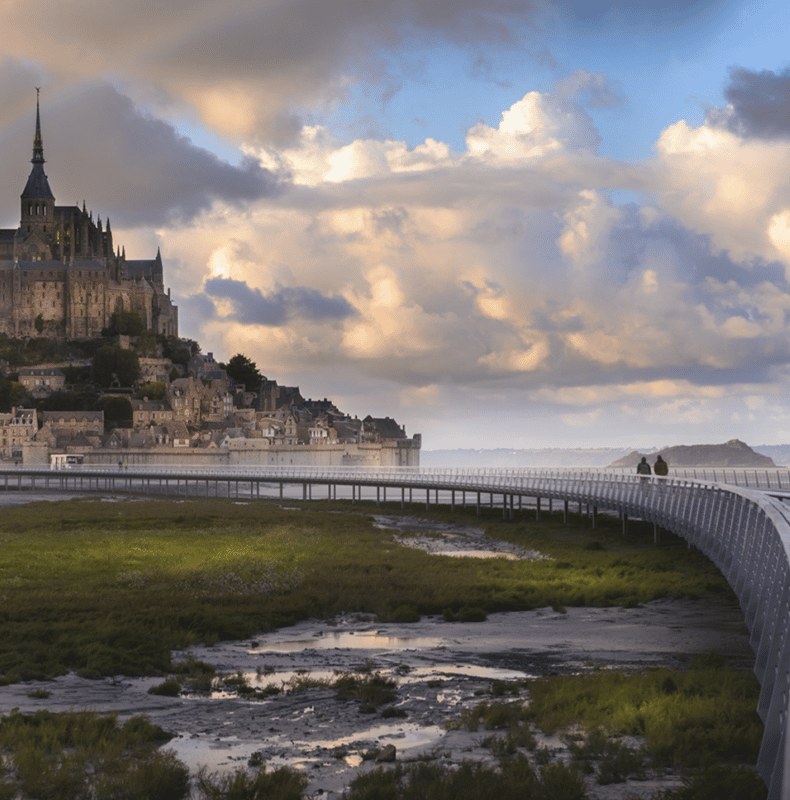
Emmanuel Frémiet’s gilded Saint Michael went up in 1897 as part of that restoration. It was restored in 1987 and regilded in 2016, which is why it still catches the light from kilometres out on the causeway. It marks the highest point of the island.
It is still a monastery
A religious community returned in the twentieth century, and since 2001 the Monastic Fraternities of Jerusalem have kept a permanent presence, brothers and sisters both. The abbey church is in use and services are open to visitors. Knees and shoulders should be covered to enter, for men and women alike.
What you will not see
Worth setting expectations. There is no treasury of gold, no famous painting, and very little furniture. What survives is the architecture itself, which is the point: bare granite, enormous piers, and rooms designed for silence. If you are expecting the painted, gilded interior of a great French church, you will be surprised by how empty this one is. Give it twenty minutes and the emptiness starts doing the work.
You will also not see the whole rock from inside. The ramparts, the Grande Rue and the parish church are outside the ticket and outside the abbey walls, and they are free at any hour — planning your visit sets out how the two halves fit into one day.
Guided, audio, or on your own
Three different products get sold under the same word. Some departures put a licensed guide inside the building with you. Others include the ticket and an audio guide, with the human commentary stopping at the door. Others include nothing but entry. The abbey page sets out which is which, and the planning page has the hours and the last-admission rule you need to fit it into a day.
Frequently asked
Can I attend Mass at the abbey?
Yes. The Monastic Fraternities of Jerusalem have kept a permanent community on the Mont since 2001 and the abbey church is still in use. Service times are set by the community rather than by the monument.
When was Mont Saint-Michel Abbey built?
Work on the great Romanesque abbey church began around 1023. The Merveille went up in the thirteenth century, the Gothic choir replaced the collapsed Romanesque one after 1421, and the spire and its gilded archangel were added in 1897.
Was the abbey really a prison?
Yes. From the seventeenth century it was progressively turned into a state prison nicknamed the Bastille of the Seas, and some 14,000 prisoners passed through before it closed in 1863. It was listed as a historic monument in 1874.
What is La Merveille?
La Merveille is two three-storey buildings raised against the north face of the rock in the thirteenth century, topped by the cloister and the monks’ refectory. The name means “the Marvel”, and it is the part of the abbey most visitors remember.
Tours that fit this trip
The departures that put a guide inside the building with you, and the ticket if you would rather go alone.